The Mission
The Interdependence Project
"This is not a resistance movement. It is a blueprint for a government for the people, by the people, and of the people — framed by the Five Pillars of Freedom."
Democracy offers the best path forward because it allows people to participate, share power, and hold leaders accountable to the needs of everyone. It is the system most capable of protecting the Five Pillars of Freedom, because it distributes power rather than concentrating it.
Democracy works best when people take part, speak honestly, and share a common understanding of truth. It cannot survive on a diet of disinformation, manufactured fear.
We decree that Government exists not only to protect people and to safeguard their basic human rights, but to help create a society where all people can live with dignity, purpose, security, and genuine freedom — not to serve the wealthy, not to impose a religion, and not to be captured by those with enough money to buy it. The people of this country are not short on ideas, compassion, or hard work. What we have lacked is a clear framework — one that is honest about what freedom actually requires, and committed to building it together.
This is that framework — grounded in the Five Pillars of Freedom, built for the long work ahead.
Watch Before Reading
The Five Pillars of Freedom are grounded in the full range of human needs.
In 1943, psychologist Abraham Maslow described a hierarchy of needs that every human being must have met in order to thrive — from the most basic physical requirements to the deepest drives for meaning and fulfillment. The Five Pillars of Freedom are built on that same foundation. When a government fails to meet these needs — when people are hungry, unsafe, isolated, unheard, or unable to reach their potential — freedom becomes an empty word. The Five Pillars translate Maslow’s universal human needs into the political and economic conditions a just society must provide.
| Five Pillars of Freedom | Maslow’s Hierarchy of Needs |
|---|---|
|
SECURITY The essential conditions every free person deserves — food, shelter, healthcare, and safety. |
Physiological Needs The essential biological requirements — food, water, shelter, and health — that keep the human body alive. |
|
PURPOSE Work that gives life meaning, dignity, and direction — and being fairly compensated for it. |
Esteem Needs The pursuit of self-respect and the desire for recognition — the sense that your contributions are valued. |
|
RELATIONSHIPS The bonds that hold society together — family, friendship, and community. |
Love & Belonging The emotional need for connection through friendship, intimacy, and being part of a supportive community. |
|
CONTRIBUTION The ability to make a meaningful difference — through work, civic life, community, and care for others. |
Esteem Needs The need for confidence, achievement, and recognition — to feel that one’s efforts matter and are valued by others and by society. |
|
AUTONOMY The freedom to shape your own life — your body, your home, your future, on your own terms. |
Self-Actualization The personal drive to reach your full potential, grow your talents, and find true self-fulfillment. |
|
AI GOVERNANCE ACT Who controls the systems that shape your life — your work, your healthcare, your rights, your democracy, and your freedom to think and choose. |
All Five Pillars Unregulated AI threatens every level of human need — from physical security and meaningful work, to trust in relationships, the ability to contribute, and the freedom to shape your own life. Section XII ↗ |
|
FEEDING THE FUTURE ACT The right to food, healthy soil, clean water, and democratic control over how food is grown and distributed — the biological foundation of all freedom. |
All Five Pillars Food is Maslow’s most fundamental need. A food-sovereign society creates secure families, purposeful work, community bonds, ecological contribution, and the ultimate autonomy of feeding yourself. Section XIII ↗ |
Why this approach matters — and what makes it different.
For generations, political debate has focused on policies, programs, and ideological battles — while the underlying human needs went unaddressed. The Interdependence Project shifts the conversation. When we start with what every person needs to actually live free, the debate changes. It is no longer “can we afford it?” It is “what kind of society do we want to be?” The Five Pillars are the answer.
A capitalist, mixed-economy model — grounded in shared prosperity.
The Interdependence Project is not socialism. It is not communism. It is a capitalist model based upon a mixed economic model — the same model that built the American middle class, funded the Interstate Highway System, created Medicare, and sent humans to the moon.
What it rejects is a system where hedge funds and billionaires grow richer every year while ordinary families work harder just to stay afloat — where profits go to the top while workers, families, and communities are left behind — where corporate oligarchs purchase Congress to further enrich themselves while working Americans cannot afford housing, healthcare, or time with their families.
We propose a market economy with strong worker protections and living wages, a strong business environment for entrepreneurs and innovation, with low inequality, universal social programs, and progressive taxation — a proven model with thriving economies in Germany, Sweden, Denmark, and Finland.
A balanced economy where private business, government, and labor work together. Businesses flourish, citizens have a respectable quality of life, and government protects and promotes both.
The shift is to an economy where private business, government, and labor work together — a balanced environment where businesses flourish to enable a respectable quality of life, and government promotes both.
The Five Pillars of Freedom
The bedrock of a just society — and our shared promise to build it.
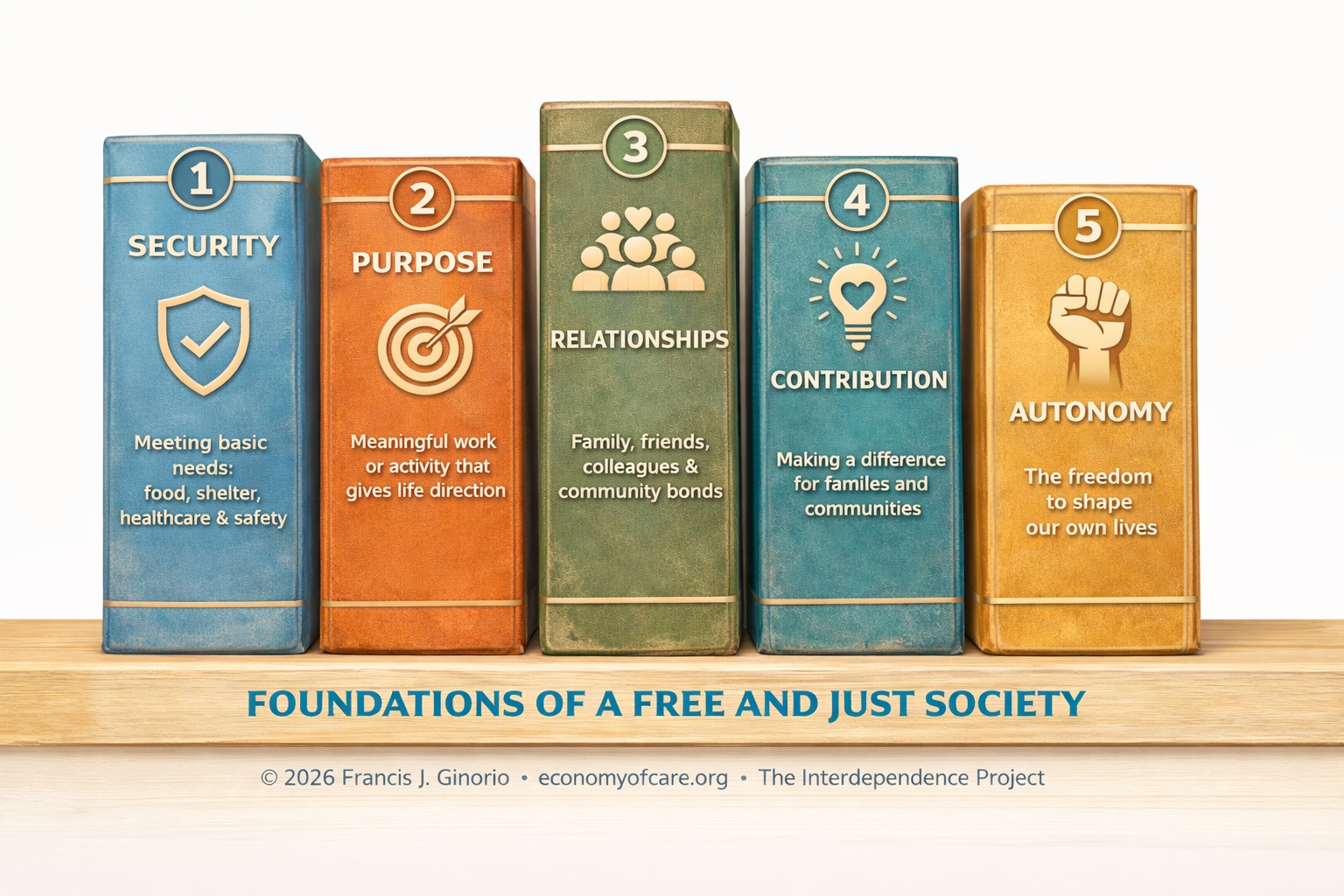
SECURITY — The Foundation of Life
Security is the foundation of everything. It means having what you need to live — a home you won’t lose, food on the table, healthcare when you’re sick, and safety in your community. These are not privileges to be earned. They are the essential conditions without which none of the other freedoms are possible. You cannot live freely when you are one bill away from losing everything.
Security means that every person has reliable access to what they need to survive and thrive: food, safe housing, healthcare, and physical safety. A society built on security does not leave people at the mercy of the market for their basic survival. Security is not charity, it is the prerequisite for freedom. When people are not afraid of losing their home, going hungry, or dying from untreated illness, they are free to contribute, to create, and to care for others.
Climate Justice is inseparable from Security. A destabilized climate threatens food production, safe housing, public health, and physical safety on a global scale. Climate justice means recognizing that communities least responsible for carbon emissions are often the first and hardest hit by climate disruption — and that a just transition to a sustainable economy must protect workers, frontline communities, and future generations. Security in the 21st century requires aggressive public investment in clean energy, climate resilience, and an Economy of Care that treats ecological survival as a fundamental human right.
PURPOSE — The Foundation of Meaning
Purpose means doing work that gives your life meaning and dignity — and being fairly compensated for it. It is not limited to paid employment. Caregiving, teaching, creating, and serving your community are all expressions of purpose. A society organized around human flourishing ensures that everyone has the opportunity to contribute in ways that are valued — and that no one is left behind by the economy.
Purpose means having meaningful work or activity that gives structure, dignity, and direction to one's life. It is not limited to paid employment — it includes caregiving, community service, artistic creation, learning, and civic participation. A society organized around purpose ensures that everyone can contribute in ways that feel meaningful, and that no one is left behind by automation, economic change, or systemic exclusion. The Economy of Care Governance Act grounds public investment in the goal of full employment — not just jobs, but purposeful roles that people can build a life around. Everyone has a real opportunity to thrive, unconstrained by poverty or lack of essential needs. The economy must be designed to serve human well-being, not profit margins or concentrated wealth.
RELATIONSHIPS — The Foundation of Belonging
Real freedom means time for the people you love. Stable housing. Childcare you can afford. A family that isn’t one crisis away from falling apart. The bonds that hold us together — that’s what freedom protects.
Relationships are the bonds that hold societies together — family, friendship, community, and civic connection. Isolation and loneliness are not merely personal problems; they are symptoms of social and economic systems that prioritize individual competition over collective well-being. A government committed to the Five Pillars invests in the conditions that allow relationships to flourish: stable housing so communities can persist, time and flexibility so families can be together, public spaces where neighbors can meet. Race, religion, gender, and identity are honored as sources of dignity, never used to divide, control, or harm. Peace guides public policy, fostering cooperation within our communities and across the world.
CONTRIBUTION — The Foundation of Participation
Freedom is not just personal — it is civic. Contribution means your voice counts, your vote is protected, and your government answers to you. It means schools that teach truth, institutions that are open and accountable to everyone, and a democracy where participation is a right — not a privilege reserved for those with money or access.
Contribution is the ability to make a positive difference for others — to give back to family, community, or society in ways that are recognized and valued. A just society creates pathways for everyone to contribute — through caregiving, civic engagement, teaching, building, healing, and organizing. It values caregiving as highly as market production. It measures economic success not by GDP growth alone, but by the richness of contribution across the whole community. Public education is grounded in truth — science, history, and critical thinking, free from censorship and misinformation. Public institutions are transparent, ethical, and accountable, with no special rules for the wealthy or powerful.
AUTONOMY — The Foundation of Freedom
Autonomy is the freedom to live life on your own terms. To make decisions about your body, your home, your work, and your future without coercion, surveillance, or domination by those with more power. But autonomy without security is an empty promise. Real freedom requires that the conditions for a dignified life are in place — so that your choices are genuinely yours to make.
Autonomy is the freedom to shape one's own life — to make meaningful choices about work, relationships, residence, belief, expression, and identity, without coercion from the state, employers, or social pressure. It is the pillar most threatened by authoritarianism, surveillance capitalism, and concentrated economic power. True autonomy requires the other four pillars as its foundation: you cannot freely choose your path if you are starving, without purpose, isolated, or unable to contribute. Democracy works when every vote counts, voices matter, and power is accountable to the whole community. The Interdependence framework treats autonomy not as an abstract right, but as a lived reality that requires active social and economic conditions to sustain.
Our Promise
We promise to work together to build a society where truth guides us, power is shared, and every person can live with dignity, freedom, and a meaningful voice in shaping their future.
One-Page Summary Documents
Print, share, or hand out at meetings. Two pages that capture the essence of the entire framework.
Program Summary
The complete framework at a glance — Five Pillars, Economy of Care, the five-part structure, and what we stand for. One page, printable.
DownloadThese five pillars are the foundation. Take time to sit with each one.
If you have comments or suggestions, we want to hear from you — visit our Discussion area. This country is filled with thoughtful and intelligent people and we look forward to your input. Keep in mind the Community Guidelines.
A Constitutional Roadmap — Policy Recommendations
This roadmap translates the principles and commitments of the Declaration of Interdependence into concrete, actionable policy reforms organized by area of interest. Every reform assumes lawful, democratic, and non-violent transformation.
How do the policy areas connect to the Five Pillars?
See the FAQ → |
Download the Mapping Chart
Constitutional Roadmap — Section XIII
The Feeding the Future Act
Section XIII: Regenerative, Agrivoltaic & Sustainable Food Production as Public Infrastructure
Food Sovereignty means that decisions about how food is grown, distributed, and accessed are made in the interests of all people — not just the corporate interests that have captured American agriculture. Food is the precondition for every other human aspiration. A society that treats the nourishment of its people as an afterthought of the market has misunderstood what a society is for.
48 million Americans were food-insecure in 2024.
Including nearly one in five children.
This is not a natural condition. It is a policy outcome — and policy can change it.
American farms produce a staggering abundance. Hunger persists because we have chosen a food system organized around extraction and profit concentration rather than around the security of the people it is supposed to serve.
Private enterprise is the engine. Public investment is the infrastructure.
Government provides the foundation nobody can afford alone.
This is the same model that built rural electrification, the Interstate Highway System, and the internet — vast public investments that created the foundation on which private farms, cooperatives, and entire new industries were built. Applied to food, the principle is the same.
Every Pillar of Freedom depends on food security:
- SECURITYFood is Maslow’s first tier — the most basic human need. Food sovereignty is Security made real: the knowledge that you and your family will eat tomorrow.
- PURPOSERegenerative and sustainable farming create skilled, knowledge-based, community-rooted employment — work that restores rather than depletes.
- RELATIONSHIPSCommunity gardens, CSAs, farmers markets, and school food programs are social infrastructure — the physical places where communities form and care for one another.
- CONTRIBUTIONRegenerative farmers rebuild soil, clean water, and sequester carbon — their work benefits everyone. It is a public good, and it deserves public investment.
- AUTONOMYFood sovereignty means democratic control over how food is produced, distributed, and accessed — the deepest form of community self-determination.
The State of American Food Production
Beneath the appearance of abundance, the foundations of American food production are eroding — literally and structurally.
- Roughly one-third of U.S. topsoil has been depleted by industrial monoculture — the irreplaceable biological capital on which all future food production depends.
- Agricultural runoff is the leading cause of water-quality degradation in U.S. rivers, lakes, and streams, fouling drinking water and creating coastal dead zones.
- The U.S. imports an estimated 70–85% of its seafood — a structural trade deficit and national-security vulnerability.
- The $3.1 billion Partnership for Climate-Smart Commodities was canceled in April 2025 — the most significant rollback of sustainable-farming investment in a generation.
- Farm consolidation has eliminated roughly 4 million farms since 1935; corporate concentration stands at historic highs.
- Three agrochemical conglomerates — Bayer/Monsanto, Corteva, and Syngenta/ChemChina — control the seeds, pesticides, and fertilizers used across most of American agriculture. A private monopoly over public nutrition.
“This is a choice between a food system that extracts and concentrates, and one that distributes and sustains.”
The Production Systems
A survey of what can rebuild American food sovereignty — each assessed on market reality, policy gaps, and its role in a mixed-economy model.
Regenerative Agriculture
Rebuilds the land it farms through cover cropping, crop rotation, reduced tillage, and integrated livestock. A $9.2B market growing at 14.5% annually.
- 25–50% reduction in input costs; 20–30% profit margin increase
- 32% more jobs per farm than conventional operations
- Carbon sequestration: 15–23 gigatons potential
- $700M USDA Pilot launched Dec. 2025
Agrivoltaic Farming
Solar panels above, crops or grazing below. 596 U.S. sites generating 10,473 MW of clean power. Peppers 3x yield; tomatoes 2x yield under panels (NREL).
- Up to 5.14x farm income vs. farming alone
- 64% more combined output per acre (Land Equivalent Ratio 1.64)
- 100,000+ rural jobs over 20 years
- No federal definition exists yet — the foundational gap to close
Integrated Food-Energy Systems
Beyond agrivoltaics: biogas/anaerobic digestion (615 farm digesters, 20,000 more feasible), wind co-location (90%+ of U.S. turbines already on farmland), geothermal greenhouses (300–600% efficiency), on-farm hydrogen, and micro-hydro.
- Biogas: 14.8M metric tons CO₂e reduced annually
- Wind: $4,000–$8,000/turbine/year lease income; 99% of cropland remains productive
- Geothermal: payback under 10 years; already running in Pacific Northwest
- Community biogas turns food waste into local energy asset
Controlled Environment Agriculture
Greenhouses and indoor farms: $114B global market (2024), 18% CAGR. Lettuce 10–15x field yield; tomatoes 3–4x; up to 90% less water. Key tool for food deserts.
- Energy cost (65–85% of opex) solved when paired with on-site renewables
- USDA crop insurance for CEA launched 2023
- Can supply fresh produce year-round in any climate
- Direct answer to food desert access failure
Aquaculture & RAS
The U.S. imports 70–85% of its seafood. Recirculating Aquaculture Systems offer a domestic answer — closed-loop, land-based, 95% water recirculation, no antibiotics, no coastal impact.
- Can be built anywhere — including inland rural communities
- Core barrier: regulatory fragmentation across USDA/NOAA/FDA/EPA
- Aquaponics (fish + vegetables) viable at school and community scale
- Solution: single federal permitting window
Urban & Community Agriculture
Urban agriculture supplies 15–20% of global food. Hydroponics (10x yield/sq ft, 90% water savings) already deployed in 96 NYC school systems. Community gardens, food forests, and school programs are social infrastructure.
- Primary barrier: zoning codes prohibit urban food production in most cities
- No federal funding for school hydroponics programs
- Community Energy-Food Centers — solar + aquaponics + CSA in every neighborhood
- Food Forest Parks: publicly maintained, freely harvested
Food as a Constitutional Right
The United States Constitution contains no right to food. The U.S. signed but never ratified the International Covenant on Economic, Social and Cultural Rights (Article 11). The federal government’s explicit position is that food security is not an “enforceable obligation.”
169 nations have accepted the legal obligation to ensure their people do not go hungry. The United States has not.
In 2021, Maine became the first U.S. state to enshrine a right to food in its constitution — passing by 61%–31%. The amendment covers the right to save seeds, grow, harvest, and consume food. A template for every other state, and for a federal constitutional amendment.
America already operates the scaffolding: 42 million Americans receive SNAP, 7 million receive WIC, and 30 million children eat school meals. These programs are architecture — but they are discretionary, not constitutional rights, subject to cuts with every budget cycle. The goal: convert existing food-assistance infrastructure into entitlements. The pipes are already laid; what is missing is the commitment to keep them flowing.
“Feed a nation, and you sustain its bodies. Let a nation govern its own food, and you sustain its freedom.”
A Two-Tier Policy Architecture
Tier 1: immediate market-shaping reforms. Tier 2: long-term public infrastructure on par with roads, power, and broadband.
Tier 1 — Immediate (1–4 Years)
- 3-year transition income bridge grants ($2B/year)
- Crop insurance reform for transitioning & agrivoltaic farms
- Federal agrivoltaic definition & standards
- Permanent 30% solar ITC + 10% agrivoltaic premium
- EQIP organic parity ($450K cap)
- OREI increase to $150M+/year
- National Organic Program: $60M/year
- REAP expansion for biogas & micro-hydro ($500M/year)
- RAS single federal permitting window
- Urban agriculture zoning federal model code
- School hydroponics/aquaponics program ($250M/year)
Tier 2 — Public Infrastructure (4–20 Years)
- National Soil Health Authority (EPA analog for soil)
- Regional Public Food Hubs (rural electrification analog)
- Universal institutional sourcing standards
- Strategic Soil Reserve (analog: Strategic Petroleum Reserve)
- Community Land Trusts for Farmland
- Right to Food constitutional amendment (Maine model)
- Food as medicine / produce prescription at Medicare scale
- Agrivoltaic Public Utility Districts (rural co-ops)
- National Food Strategy Act (10-year plan, binding targets)
- 25% organic farmland by 2035 (EU Farm to Fork model)
This Is Not Government Farming
Every policy in this architecture is consistent with — indeed, strengthens — a mixed-economy capitalist model. Farmers own their land and earn profit. Food businesses compete within standards, just as automakers compete within safety regulations. Standards make markets trustworthy, not suppressed.
The most productive agricultural sectors in the world — Germany, Denmark, and the Netherlands — operate within strong public-investment frameworks, not despite them. The Netherlands is the world’s second-largest agricultural exporter on a sliver of land, precisely because public investment made its private farms world-beating.
Every dollar spent at a local farmers market recirculates 2–3 times in the local economy. Community-owned food hubs keep margins local rather than routing them to national distributors. Urban agriculture creates local jobs that cannot be offshored. On-farm energy means farm energy costs stay in the community.
This is not a choice between capitalism and socialism. It is a choice between a food system that extracts and concentrates — and one that distributes and sustains.
The Economy of Care
Governance Act
Section VII: Fiscal Policy & Economic Democracy
Economic Democracy means that economic decisions — what gets funded, what gets built, who benefits — are made in the interests of all people, not just those who hold wealth. It means an economy governed by the same democratic principles we apply to politics: accountability, participation, and the common good. When the government invests in healthcare, jobs, childcare, and clean energy as public priorities, that is Economic Democracy in action.
The U.S. Government CANNOT Run Out of Money
and can NEVER go bankrupt.
The Federal Government creates every single U.S. dollar in circulation.
We’ve been told that all programs from the Federal Government are funded by taxes. Economists echo this by saying the Federal budget must be managed like our household budget — just like we sit at the kitchen table and work out how to pay for the mortgage, buy food, and pay for our medical insurance.
IN FACT — this is not how money and the budget operate.
The question has never been whether we can afford healthcare, childcare, or a living income. The question is political will.
The question is not "can we afford it?"
The question is whether we have the political will. And that is up to us.
Explore the Five Pillars of Freedom →Real Lives. Real Stakes. Real Solutions.
These are not statistics. They are the neighbors, veterans, parents, and seniors who live the policies we are fighting to change. Each story connects to a pillar — and to a solution.
"I asked them for help, pleading — there's something wrong."
Kelly Smith served her country. When she started experiencing dangerously high blood pressure, she asked the VA for a cardiology referral. She was denied because she wasn't taking enough medications to qualify. She kept asking for help. She was placed on a two-year mental health waitlist. Months later, she suffered a heart attack. A subsequent MRI revealed signs of a serious neurological condition the VA could have caught earlier.
She is not alone. There are 18 million veterans in America. Only 6 million use VA care. The suicide rate among veterans is 72% higher than among non-veteran adults. A third-generation veteran writing in STAT News described his VA experience: "A three-week wait for mental health care was its best offer — unless I was on the brink of self-harm."
"I feel it was 100% avoidable. If they had listened to me in the beginning, the disease I have now would have been found by them."
— Kelly Smith, retired veteran, via KTXS News, September 2025
The Solution
Veterans who serve deserve automatic, universal enrollment in healthcare — not a bureaucratic labyrinth. This is Section V of the Constitutional Roadmap — Human Rights & Civil Liberties — and a core commitment of the Five Pillars under SECURITY.
"They asked me to train the person who was taking my job."
Across America, workers are being asked to do something that defies dignity: spend their final weeks at a company training their overseas replacements. According to a 2024 Resume Builder survey, more than 20% of companies required outgoing U.S. employees to formally train offshore hires as part of their offboarding process.
Since 2001, the trade deficit with China has led to the loss of an estimated 3.82 million American jobs. One in five American companies replaced laid-off U.S. workers with offshore workers in 2024 alone. Roughly 300,000 American jobs are outsourced every year. These are not abstract figures, they are communities hollowed out, families upended, and workers stripped of the purpose that a meaningful job provides.
"American jobs are being outsourced to other countries and our people can't find jobs… This outsourcing for cheaper labor is a huge problem."
— Kelly Smith Bishop, community member, via Facebook, October 2024
The Solution
A Federal Job Guarantee ensures everyone who wants to work can — at a living wage. Antitrust and trade reform stops monopolies from offshoring labor to maximize profit at workers' expense. See Sections VII and VIII of the Constitutional Roadmap.
"54% of parents are skipping groceries to buy school supplies."
Maria works two jobs. She has three children in school. Every August, the same impossible math: backpacks, binders, calculators, and supplies she can't afford. A 2025 Intuit Credit Karma survey found that 44% of American parents plan to go into debt for school supplies — a 10-point jump from the previous year. More than half are skipping groceries to cover school costs.
Raising a child from birth to high school now costs an estimated $300,000. Seven in ten Americans now say raising children is too expensive. For the first time in the history of the American Family Survey, finances are the number one reason families are limiting how many children they have. The richest country in the world is making it impossible for people to build families and give their children a promising future.
"Families are telling us loud and clear that the cost of raising children is pushing them toward decisions they never thought they'd have to make."
— Sarah Rittling, Executive Director, First Five Years Fund, November 2025
The Solution
Tuition-free public education, universal childcare, and fully funded public schools are rights, not luxuries. No family should go into debt to send their children to school. This is Section VI of the Constitutional Roadmap and a central commitment of the RELATIONSHIPS pillar.
"Seniors shouldn't have to choose between food and medication."
Picture an elderly woman at her kitchen table. Two things in front of her: a bottle of heart medication and a nearly empty grocery bag. She can afford one. This scene plays out every day across America. About 20% of adults 65 and older skipped or delayed medications due to cost in the past year. Nearly 7 million seniors face food insecurity. Over one-third of adults aged 50 and older have given up necessities like food to afford healthcare.
Meanwhile, only 4 in 10 eligible seniors over 60 use SNAP — the food assistance program they've earned the right to access. Paperwork alone defeats people who are already exhausted, sick, and surviving on fixed incomes. Their dignity is not a budget line item. It is a moral obligation of a society that claims to value its elders.
"Seniors shouldn't have to choose between food and medication. I worked to cap the cost of prescription drugs for seniors — now that work is being undone."
— Senator Raphael Warnock, January 2025
The Solution
Cap prescription drug costs. Expand Medicare. Protect Social Security. Simplify access to SNAP and nutrition programs. The Economy of Care recognizes that caring for our seniors is not a cost — it is an investment in the dignity of our society. See Section VI of the Constitutional Roadmap.
Your Story Matters
Have you had to choose between food and medicine? Lost a job to outsourcing? Struggled to access VA care? Been priced out of housing or childcare? Your story is the reason this platform exists. Share it. You may change someone's mind, move a legislator, or help a neighbor feel less alone.
Share Your StoryStories are reviewed before publication. Your name is optional. Contact us at economyofcare@pm.me
Constitutional Roadmap — Section XII
The AI Governance Act
Section XII: Artificial Intelligence & Digital Rights
Digital Democracy means that decisions about artificial intelligence — how it is built, who controls it, and whose values it reflects — are made in the interests of all people, not just those who hold technological or economic power. Without democratic oversight, AI will deepen inequality, erode privacy, concentrate power in fewer hands, and undermine the very elections and institutions that make freedom possible.
AI is the most powerful technology ever built —
with no boundaries.
Nearly all the knowledge about how these systems work is kept secret — we are in the dark.
Congress, at the behest of the billionaires, passed legislation prohibiting regulations on AI development — our jobs, our future, our well-being is irrelevant.
According to the Center for Humane Technology’s AI Roadmap (2026), AI development has limited privacy protections and no ethical guide for its use — no government rules to govern the behavior of AI companies.
We know that these AI companies will exploit every avenue to acquire power and profits.
It’s not only our families who pay the price — but all our neighbors, all over the world.
The question is not whether AI will reshape society. It will.
The question is: who shapes the terms?
Every Pillar of Freedom is threatened by unregulated AI:
- SECURITYAI systems are making life-altering decisions about healthcare, housing, and criminal justice with no accountability.
- PURPOSEJob displacement is accelerating without any worker input, transition support, or equitable sharing of the gains.
- RELATIONSHIPSTrust is being eroded by AI-generated fake news, deepfakes, and the elimination of human customer service.
- CONTRIBUTIONAI-powered disinformation is corrupting elections and undermining democratic participation.
- AUTONOMYSurveillance and behavioral manipulation are stripping away the freedom to make decisions about your own life.
The AI Governance Act addresses all five. It is the framework for making AI serve people — not the other way around.
History will judge this moment — not by how fast we moved, but by whether we moved wisely.
The AI Governance Act is part of the Constitutional Roadmap — a framework for governing that puts people first. Read the full roadmap, explore the Five Pillars, and bring this framework to your elected representatives.
Explore the Constitutional Roadmap →Partnering Communities
Six working coalitions — each with targeted strategies for building power, trust, and concrete wins. Click any heading to see the full engagement strategy.
1. Working‑Class & Labor Communities
Focus: Jobs, Healthcare, Housing, Unions, Cost-of-living relief
- ›Open the door to organizing everywhere
- ›Seed organizing in new sectors
- ›Community-rooted labor hubs
- ›Support alternative vehicles where unions are blocked
- ›Link workplace issues to community issues
- ›Leadership development from the base up
- ›Make victories visible
2. Faith Communities
Core message: Faith is strongest when it is chosen — not imposed.
- ›Listening circles with clergy and lay leaders
- ›Model sermons, study guides, discussion prompts
- ›Interfaith freedom coalitions
- ›Legal & advocacy support for congregations
- ›Lift up respected faith voices for pluralism
3. Small Business Owners
Core message: Real competition, not monopolies, is the backbone of free enterprise.
- ›Roundtables on fees, credit access & platform dependence
- ›Plain-language policy briefs for business owners
- ›Partner with chambers, Main Street alliances & co-ops
- ›Toolkits on collective procurement & co-ops
- ›Highlight success stories where breaking monopolies lowered costs
4. Veterans & National Security Voters
Core message: A strong nation protects its people, alliances, and democracy.
- ›Veteran councils on anti-corruption & foreign influence
- ›Vet-to-vet outreach town halls
- ›Transition programs & public-service pathways
- ›Security-framed narratives: clean government = strong defense
- ›Veterans' organizations on voting rights & foreign money in politics
5. Young People & Students
Core message: Your future should not be stolen by debt, climate collapse, or authoritarianism.
- ›Campus & online assemblies on debt, climate & digital rights
- ›Youth-led councils & democracy hubs
- ›Digital organizing toolkits & content packs
- ›Tangible wins: debt relief, public investment in education, climate internships
- ›Youth representation on oversight & budgeting bodies
6. Centrists & Institutionalists
Core message: This is about restoring stability, legitimacy, and trust.
- ›Frame reforms as institution-repair, not revolution
- ›Non-partisan forums with judges, regulators & civil servants
- ›Incremental but durable steps: ethics rules, oversight with teeth
- ›Risk-and-stability briefs for business & geopolitical audiences
- ›Invite centrists into oversight, auditing & standards-setting roles
The Declaration of Interdependence
A comprehensive framework for human dignity and democratic governance. This declaration establishes the inherent rights of all human beings — recognizing that these rights are universal, inalienable, and essential to the foundation of a free and just society.
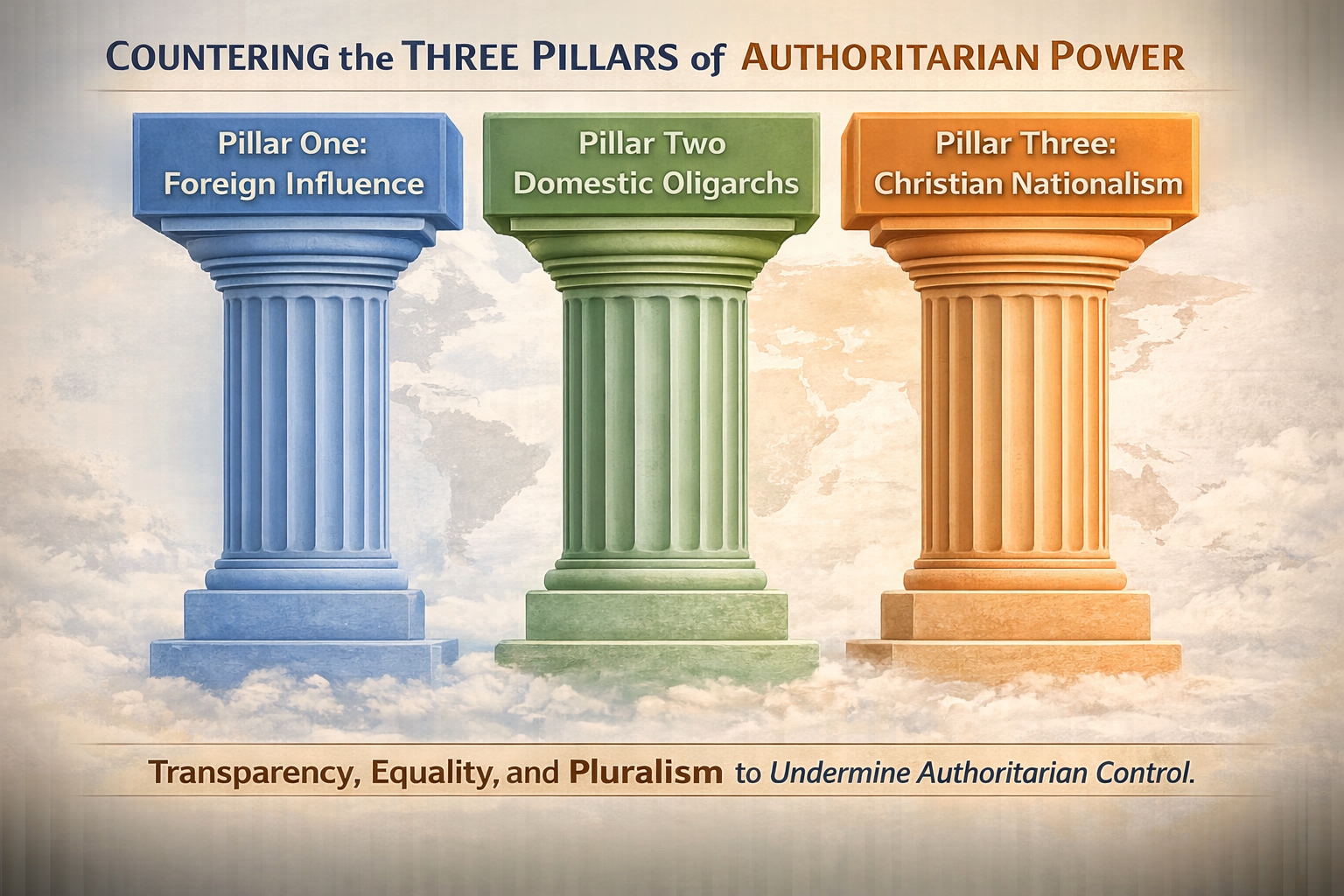
Pillar One
Foreign Authoritarian Influence
External destabilization through compromised leadership and disinformation.
- ›Mandatory financial transparency for officials
- ›Independent foreign influence audits
- ›International anti-money-laundering enforcement
- ›Intelligence cooperation restoration
- ›Media literacy & disinformation resilience programs
Pillar Two
Domestic Oligarchs
Monopoly control of business, loss of protections through deregulation, and poverty through income inequality.
- ›Progressive taxation of extreme wealth
- ›Antitrust enforcement with criminal penalties
- ›Public banking & payment systems
- ›Labor empowerment & sectoral bargaining
- ›Breaking up asset manager monopolies & common ownership
- ›Mandatory divestiture & structural limits on financial power
- ›Data protection & public data trusts
Pillar Three
Christian Nationalism
Imposition of strict religious laws and loss of personal freedoms.
- ›Absolute protection of freedom of belief
- ›Secular public education standards
- ›Enforcement of church-state separation
- ›Interfaith & secular coalitions
- ›Narrative reframing: faith as personal, not governmental
Educational Resources
Understanding the Ideas Behind This Framework
Featured Resource
“Can We Afford It?”
Every time Congress debates healthcare, housing, or public investment in education, the same three words end the conversation: “We can’t afford it.” This 8-page FAQ examines that claim program by program — using Modern Monetary Theory to explain why the real constraint is never money. It is always real resources, political will, and who the system is designed to serve.
Modern Monetary Theory (MMT)
The Economy of Care Governance Act is grounded in Modern Monetary Theory (MMT) — a framework that explains how money actually works in a sovereign currency economy. Professor Richard Murphy, Emeritus Professor of Accounting Practice at Sheffield University Management School, has produced a comprehensive series of accessible videos explaining MMT, including how governments create money, why tax controls inflation rather than "paying for" spending, and why austerity is always a political choice rather than an economic necessity.
What Modern Monetary Theory Actually Says and Why It Matters
A clear, myth-busting introduction to MMT — what it is, how it works, and what it doesn't claim to do. Essential starting point.
Watch on YouTube →Modern Monetary Theory Isn't 'Just Theory' — It Describes How Money Actually Works
Murphy walks through the real sequence of government spending: Parliament authorizes, Treasury instructs, Bank of England settles — and only then does tax reclaim money. Austerity exposed as a political choice.
Watch on YouTube →Don't Ask When We're Going to 'Do' MMT — We Already Are
MMT is not a policy program — it's a description of how the monetary system already works. This video explains why the question "when do we do MMT?" misunderstands what MMT is.
Watch on YouTube →Why Modern Monetary Theory Fails Without Tax
Tax is not about funding government spending — it controls inflation, creates demand for currency, and sustains democracy. Without tax, MMT collapses.
Watch on YouTube →Everything You've Been Told About Tax Is Wrong
The six real purposes of tax in an MMT framework: ratifying the currency, controlling inflation, redistributing wealth, repricing harmful activity, strengthening democracy, and organizing the economy for public purpose.
Watch on YouTube →12 Questions That Expose the Truth About Money
Governments create new money every time they spend. Taxation removes money to control inflation. That's not a theory — it's how the Bank of England says money works.
Watch on YouTube →Why Is the Left So Frightened of Modern Monetary Theory?
A challenge to progressive politics: the power to create money and invest in people already exists. Austerity and poverty are political choices, not economic necessities.
Watch on YouTube →Greenspan: "There Is Nothing to Prevent the Government from Creating as Much Money as It Wants"
When Congressman Paul Ryan suggested privatizing Social Security would make it more solvent, Alan Greenspan — former Federal Reserve Chairman — responded that privatization was unnecessary because the federal government can create as much money as it wants to cover Social Security obligations for as long as needed.” Taxes do not fund the federal government. They manage inflation and inequality. Cutting programs that protect the foundations of freedom is not fiscal responsibility — it is a political choice to abandon people.
Watch on YouTube →Understanding the Declaration of Interdependence
An in-depth walkthrough of the Declaration and its implications for democratic governance in the United States.
Coming SoonThe Economy of Care in Practice
How the Economy of Care Governance Act applies MMT principles to real public investment — healthcare, education, infrastructure, and climate resilience.
Coming SoonBuilding Democratic Coalitions
Strategies for building working coalitions across labor, faith, business, veteran, youth, and centrist communities for democratic renewal.
Coming SoonThe Five Policy Programs — How They Work
Each of the Economy of Care Governance Act's five programs has a strong evidence base and real-world precedent. These videos explain how universal healthcare, a federal job guarantee, childcare, a living income, and clean energy investment actually work in practice — and why they are affordable.
Universal Healthcare? Not as Radical As You Think
A clear, accessible case for universal healthcare in the US — how it works, why every other developed country has it, and what America is missing. TEDx Talks. (12 min)
Watch on YouTube →Anatomy of Healthcare: The U.S. System Explained
How the US healthcare system compares to global models — four fundamental approaches explained by a doctor. Essential context for understanding the policy debate. Med School Insiders. (10 min)
Watch on YouTube →Harvard Professor Explains the Basics of Universal Basic Income
Longitudinal research data on UBI outcomes — better health, higher graduation rates, stronger civic participation. A credible academic overview of the evidence. Harvard Kennedy School. (6 min)
Watch on YouTube →Rep. AOC Advocates for Universal Child Care Bill
Congresswoman Alexandria Ocasio-Cortez makes the case for universal child care at a press conference for the New Affordability Agenda. Current legislation, April 2026. RepAOC. (3 min)
Watch on YouTube →The Green New Deal, Explained
What’s actually in the Green New Deal — a clear, balanced explainer of what it proposes, what it would cost, and why its proponents argue it’s necessary. Vox. (7 min)
Watch on YouTube →Artificial Intelligence & Democratic Governance
AI is already reshaping how we work, communicate, and govern. These resources explain the risks, the principles for democratic oversight, and what legislation can do to ensure AI serves people rather than concentrating power in the hands of a few corporations or governments.
Featured Download
The AI Roadmap: How We Ensure AI Serves Humanity
Center for Humane Technology’s 2026 report. Seven principles for how AI should be built, deployed, and governed. The definitive framework for democratic AI oversight.
The A.I. Dilemma
Tristan Harris and Aza Raskin of the Center for Humane Technology discuss how existing AI capabilities already pose catastrophic risks to democracy and society — and what must change. Essential viewing. (67 min)
Watch on YouTube →AI Expert: What the World Looks Like in 2 Years
Tristan Harris, co-founder of the Center for Humane Technology, warns that AI will hack democracy, threaten jobs, and blackmail humans by 2027 — and explains what democratic governance must do now. Diary of a CEO. (2 hrs)
Watch on YouTube →The Five Pillars in Action
These videos connect the Five Pillars of Freedom to real-world policy debates — from the federal job guarantee and wealth inequality to voting rights, climate justice, and the threat of disinformation to democracy. Watch these to see the conditions for freedom playing out in current events.
Why We Need a Federal Jobs Guarantee
13 million people looking for living-wage work is not full employment. Economist Pavlina Tcherneva explains the economic and social case for a federal jobs guarantee. New Economic Thinking. (15 min) — Pillar: Purpose
Watch on YouTube →Why Billionaires Fear This Economist
Gabriel Zucman — one of the world’s leading economists on wealth inequality — explains how billionaires avoid tax, why 70–80% of Americans support a wealth tax, and how democratic forces have beaten oligarchic ones before. Rutger Bregman. (23 min) — Pillar: Security & Autonomy
Watch on YouTube →Climate Justice Explained
How climate justice connects science, policy, and people — recognizing diverse voices, ensuring fair access to resources, and why justice is essential for meaningful climate action. UN University. (8 min) — Pillar: Security
Watch on YouTube →Why Was the Voting Rights Act Necessary — and How Has It Been Weakened?
From the founding era to the 2026 Supreme Court ruling, a comprehensive history of who could vote in America, how those rights were won — and how they are being taken away. Anti-Social Studies. (17 min) — Pillar: Contribution
Watch on YouTube →The Democracy Dilemma: Social Media, Disinformation & Election Integrity
From digital voter suppression to disinformation campaigns — NYU professors, investigative journalists, and policy experts explain how big tech is threatening democracy and what can be done. Exposure Labs. (55 min) — Pillar: Contribution
Watch on YouTube →Understanding the Framework
Common questions about the Five Pillars, the Economy of Care, and the Constitutional Roadmap.
What is the Economy of Care — and how is it different from regular government spending? +
The Economy of Care is the economic framework at the heart of this project. It is grounded in Modern Monetary Theory (MMT) and recognizes a fundamental truth that most political conversations ignore: the federal government creates its own currency. It does not need to collect taxes before it can spend — it creates money when it spends, and removes money when it taxes.
This means the real constraints on government spending are not financial — they are real resources: labor, materials, energy, ecological capacity. The question is never "can we afford to guarantee healthcare?" The question is "do we have enough doctors, nurses, hospitals, and medicine?" When we do — and we do — the government can fund it.
Alan Greenspan, as former Federal Reserve Chairman, confirmed this directly: "There is nothing to prevent the government from creating as much money as it wants." When Congressman Paul Ryan suggested privatizing Social Security would make it more solvent, Greenspan responded that “privatization was unnecessary — the federal government can create whatever money is needed to cover Social Security as long as needed.
Taxes under MMT serve a different purpose: they control inflation, reduce inequality, discourage harmful activity, and create demand for the currency. They do not "pay for" programs. Cutting healthcare, housing, or education programs to "balance the budget" is therefore not fiscal responsibility — it is a political choice to abandon people.
Why are Human Rights (Section V) and Economic Rights (Section VI) assigned to the SECURITY pillar? +
Security — the First Pillar of Freedom — is grounded in Maslow’s physiological and safety tiers: the basic conditions without which no other human aspiration is reachable. Human rights (Section V) and economic rights (Section VI) belong at this foundation because they define the minimum legal and material conditions a just society must guarantee every person.
Without enforceable human rights, a person has no protection from the state or from those with power over them — no recourse when their basic security is violated. Without economic rights — to a living wage, healthcare, housing, and food — the formal rights of citizenship are hollow. You cannot vote freely if you are starving. You cannot access justice if you cannot afford a lawyer.
The Interdependence Project assigns these sections to the Security pillar because security is not only physical safety — it is the full set of conditions that allow a person to live without fear. Human and economic rights are the legal and material architecture of that security.
What is the Federal Job Guarantee and how does it relate to the PURPOSE pillar? +
The Federal Job Guarantee is a permanent, federally funded, locally administered program that offers a voluntary living-wage job with benefits to anyone who wants one. It is the direct legislative expression of the PURPOSE pillar.
Purpose means more than employment — it means meaningful activity that gives structure, dignity, and direction to life. The Job Guarantee is designed not just to reduce unemployment statistics but to ensure that everyone who wants to contribute to their community has a real opportunity to do so.
It also functions as an automatic economic stabilizer: when the private sector contracts and unemployment rises, the Job Guarantee expands; when the private sector grows, it contracts. This keeps the economy near full employment without the inflationary surges that traditional demand stimulus produces. The Job Guarantee anchors the price level — the minimum wage it pays becomes the economy-wide wage floor.
Is this a Democratic Party platform, a liberal platform, or something else? +
It is a platform for freedom and justice — grounded in democratic values and the principle that government exists to protect people and safeguard their basic human rights. The framework proposes it as a platform for the Democratic Party because that party is currently the most viable vehicle for progressive governance, but the principles themselves transcend partisan affiliation.
The Five Pillars — Security, Purpose, Relationships, Contribution, and Autonomy — are not ideological abstractions. They describe conditions that virtually every person, regardless of party, recognizes as essential to a good life. The policy positions that follow from them are grounded in evidence, economics, and democratic theory — not in partisan identity.
The framework assumes lawful, democratic, non-violent transformation. It works through elections, coalition-building, and democratic deliberation — not through shortcuts or unilateral action.
I Stand With This
Add your name to the growing list of people who believe in an economy organized around care, dignity, and freedom for all.
Add Your Name
Standing With This:
Names shown are from your current session. To permanently record your declaration, email economyofcare@pm.me.
Discussion
Join the conversation about interdependent governance, the Five Pillars of Freedom, and the future of American democracy.
Contact
Let's Connect
We welcome questions, feedback, collaboration proposals, and stories from people who share this vision. Reach out and help build this movement.
- economyofcare@pm.me
- Frederick, Maryland
Support the Movement
Help Expand the Interdependence Project
You’ve explored the vision. You’ve read the stories. If this framework moves you, consider contributing to help carry it further—across social media, into county and city councils, state legislatures, and to Congress.
Every contribution, large or small, helps expand the conversation about a government that works for all people.
The Interdependence Project is an independent civic initiative by Francis J. Ginorio.
Contributions support outreach and community organizing efforts.
Community Guidelines
This space is for:
This space is not for:
Moderated by economyofcare@pm.me — Violations may result in comment removal. We believe in free expression and robust debate, not in safe spaces from ideas. We do believe in protection from cruelty.